Designing Synth Envelopes: ADSR, CV, and Musical Patch Control
Published: July 24, 2026
⏳ Why envelopes matter
Envelopes turn a held note into a musical shape. In subtractive synthesis they control volume, filter brightness, and modulation depth; in modular systems they define attack, sustain, and motion. A well-designed envelope generator is the difference between a static patch and one that breathes.
Unlike oscillators and filters, envelope generators are event-driven. They respond to gate and trigger signals, convert timing into voltage, and feed that voltage into VCAs, VCFs, and modulation destinations. That makes them essential for expressive playing, dynamic patches, and stable performance across different synth architectures.
ADSR is a starting point, not an end point
Attack, decay, sustain, release are the most familiar envelope parameters, but the practical engineering challenge is making them behave musically with real control voltages and gate sources. This means calibrating time ranges, managing gate polarity and retrigger behavior, and choosing curve shapes that suit both percussive and sustained patches.
🔌 Gate vs trigger: what every synth driver should know
In modular synths, a gate is a sustained voltage that stays high while a key is held; a trigger is a brief pulse at note-on. Envelope generators must support both. Use gate inputs for traditional ADSR behavior, and trigger inputs for one-shot percussion envelopes and retriggered AR shapes.
A robust envelope design includes input conditioning: clean the gate with a Schmitt-like threshold, reject chatter on mechanical switches, and detect the rising edge for a reliable trigger. In digital designs, debounce gate signals and derive trigger events from the edge rather than raw voltage level.
🎚️ Practical ADSR and CV scaling
Real ADSR modules have two separate ranges: time and level. Time controls should span milliseconds to several seconds, and CV inputs should allow exponential-style scaling for musical response. A linear knob can feel too slow in the lower range if the underlying time constant is also linear.
In analog circuits, use a log taper pot or a JFET-linearized timing capacitor network. In digital modules, map CV to time using a curve such as time = base * exp(cv * k). This preserves detail at short times while still reaching slow releases.
📐 Curve shapes and response tuning
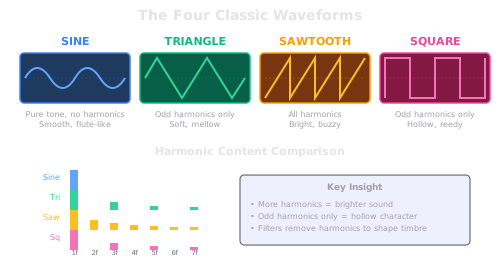
Envelope shapes are more than ADSR. Use exponential attack and release for natural-sounding motion, and reserve linear segments for precise control. For percussive sounds, a log-style decay gives punch without sounding mechanical; for pads, a smooth exponential rise and fall feels more organic.
In digital implementations, generate curves with simple exponentials or piecewise polynomial approximations. Avoid hard linear corners on the output voltage: they can create audible steps when used as a VCA control signal. A small amount of smoothing on the CV output removes clicks while preserving responsiveness.
⚙️ Retriggering, hold, and multi-stage envelopes
Retrigger behavior is one of the most important envelope design decisions. When a new note arrives while the previous envelope is still releasing, should the envelope restart immediately, reset to zero, or continue from its current level? Designers often provide multiple modes to support both smooth legato and tight keyboard response.
Add a hold stage for dedicated percussion envelopes, and consider a separate sustain/gate path that keeps the envelope level while the key is held. In modular patches, the same envelope generator should be capable of VCA control, filter gating, and modulation destination output without changing its fundamental timing behavior.
🧪 Patch examples and testing
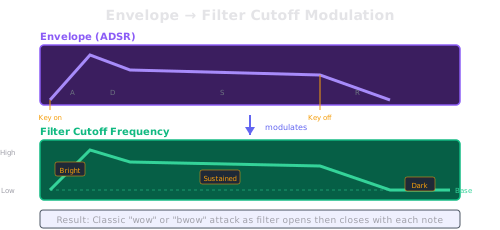
Use envelopes in three classic roles: VCA control for amplitude shaping, VCF control for brightness sweeps, and modulation source for timbral motion. For percussive sounds, keep attack fast and decay short. For pads, slow attack/release so the sound breathes. For plucks, use fast attack with a non-linear decay curve.
Test envelope generators with a simple patch: connect the output to a VCA and a filter cutoff, then play sustained notes, quick staccato patterns, and legato runs. Watch for clicks at note-on and note-off, and verify that the envelope behaves consistently when gate width varies from 50 ms to several seconds.
🔧 Implementation tips
In analog designs, keep timing capacitors stable and route gate/trig signals through buffers to avoid load-induced jitter. In firmware, separate the envelope state machine from the output smoothing stage: calculate the next target voltage, then interpolate it smoothly on the audio-rate path. This prevents quantization or step noise from appearing in the final control voltage.
If you model envelopes digitally, use a high-resolution timer or sample the gate input at a fast rate. Convert gate input voltage to a stable boolean, then drive the ADSR stage from that clean event. If you implement CV inputs, scale them with high precision and clamp output values to avoid over-driving downstream VCAs or filters.